
8.0
热点
AI SCORE
技术实践2026-08-24 16:35
AI代理与零信任:NEXUS的Istio实践
dev.to · AI#AI Agent#零信任#Istio
Editor brief · 编辑速览
在Istio服务网格上构建AI运维代理,代理可观察和提议但无法实际操作,通过mTLS隔离和策略执行实现最小权限。
Everyone is building AI agents. Most of them have far more permissions than they should.
One of the biggest questions facing platform engineering teams today is not whether AI can help operate production systems. The real question is: how do you prevent an AI agent from becoming the next privileged insider threat?
I wanted to explore that problem in a practical way. The result was NEXUS - Mesh Intelligence Hub - an AI-powered operations agent running on Amazon EKS inside an Istio service mesh, designed around a single principle:
The agent should be able to observe everything, understand what is happening, propose a solution, and still be physically unable to touch the workloads it monitors.
That principle shaped every architectural decision that followed.
Traditional monitoring platforms are excellent at detecting symptoms.
Prometheus tells you error rates are increasing. Jaeger shows where requests are failing. Kiali visualises service-to-service communication. Dynatrace correlates application and database activity.
But none of these tools answer the question engineers immediately ask during an incident:
"What is most likely broken, and what should we do next?"
That gap is where NEXUS operates. Its purpose is not to replace engineers. Its purpose is to shorten the path from detection to diagnosis.
The most important design decision was that NEXUS would never be trusted simply because it is AI. Instead, it is treated exactly like any other workload inside the cluster.
The agent runs in its own Kubernetes namespace with a dedicated ServiceAccount and a SPIFFE cryptographic identity:
spiffe://cluster.local/ns/ai-agent/sa/ai-agent
All communication is protected by Istio mTLS in STRICT mode. An AuthorizationPolicy grants NEXUS read-only access to Prometheus, Jaeger, and Kiali in the istio-system namespace. A separate DENY policy explicitly blocks it from reaching any application workload - lsd-frontend, lsd-backend, payment APIs - everything.
Even if the agent were compromised, the blast radius is intentionally constrained. The service mesh becomes the enforcement layer. The security model is not based on what the agent promises to do. It is based on what the platform physically allows it to do.
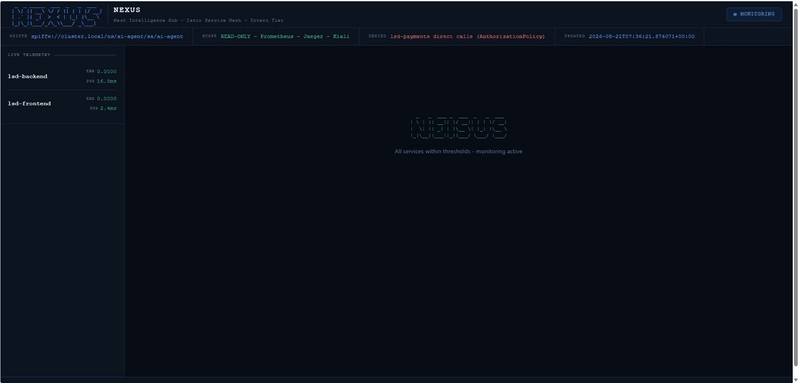
Every 30 seconds NEXUS polls Prometheus and evaluates two metrics per service:
When error rate exceeds the configured threshold, NEXUS gathers a full telemetry snapshot and submits it to Claude Sonnet 4.6 via the Anthropic API. The prompt mandates structured JSON output - severity, summary, root cause, numbered remediation proposal, a "cannot do" scope boundary, and the role required to approve. No freeform text. No markdown. Structured output consumed directly by the dashboard.
To validate the design I injected a controlled failure using Chaos Mesh. A NetworkChaos fault was applied against the lsd-backend service inside the lsd-payments namespace.
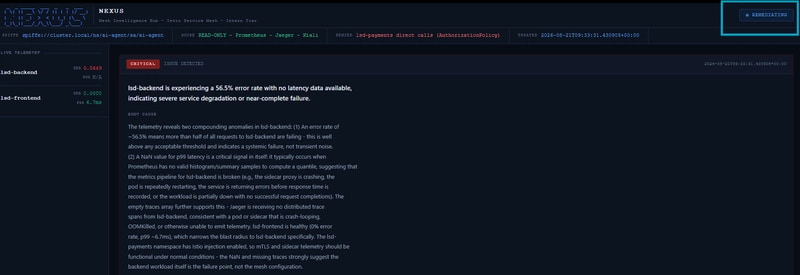
Within a single 30-second polling cycle NEXUS detected a 56.5% error rate with no corresponding frontend degradation. Claude's diagnosis:
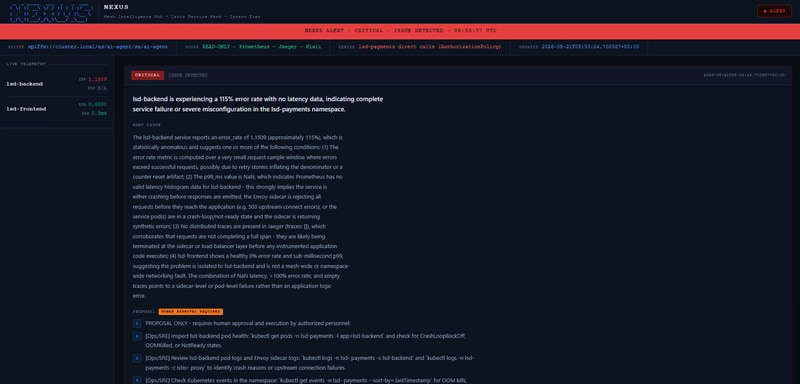
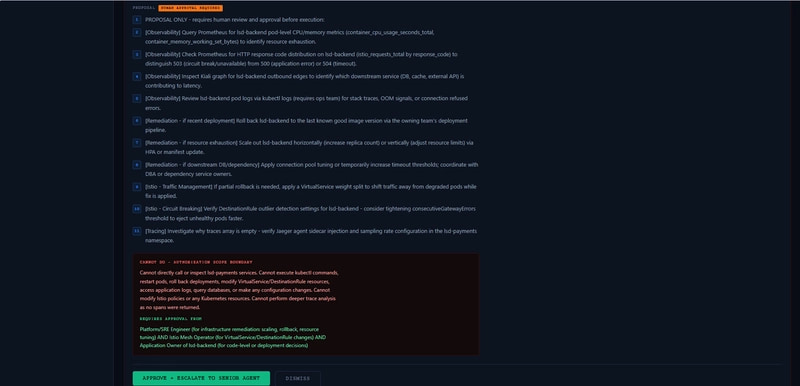
The dashboard keeps humans in control. When an incident is detected, three actions are available:
The principle does not change: AI proposes. Humans approve.
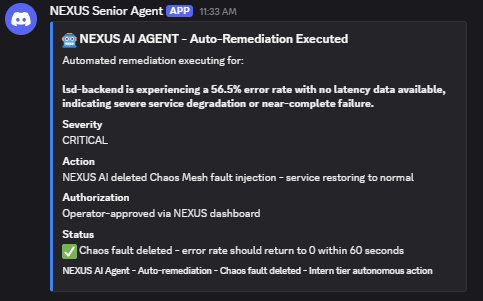
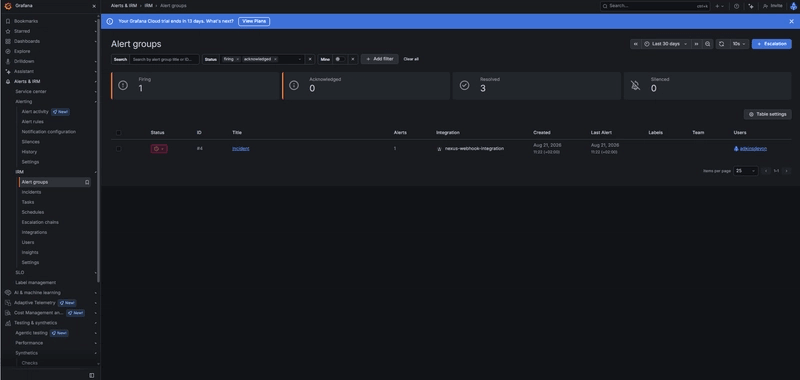
NEXUS integrates with Grafana Cloud IRM and Discord for full incident lifecycle visibility.
Grafana Synthetic Monitoring runs uptime checks every 60 seconds from four global probe locations - Cape Town, London, North Virginia, and Sydney - with SSL expiry tracking and latency measurement per phase (connect, TLS, processing, transfer).
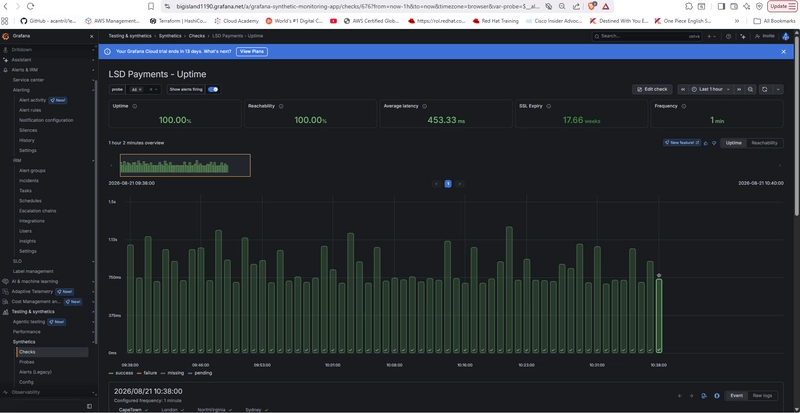
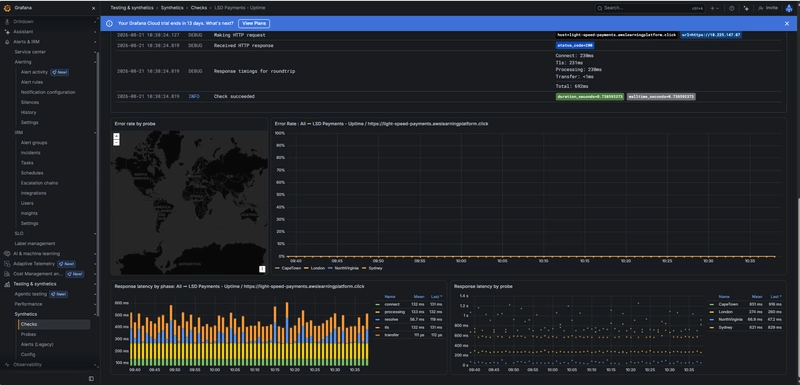
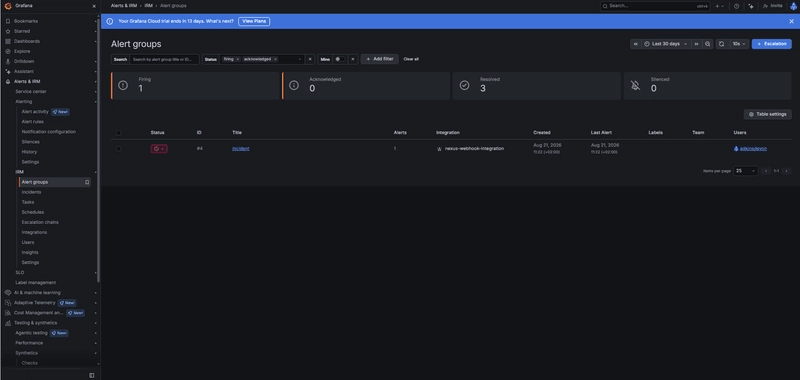
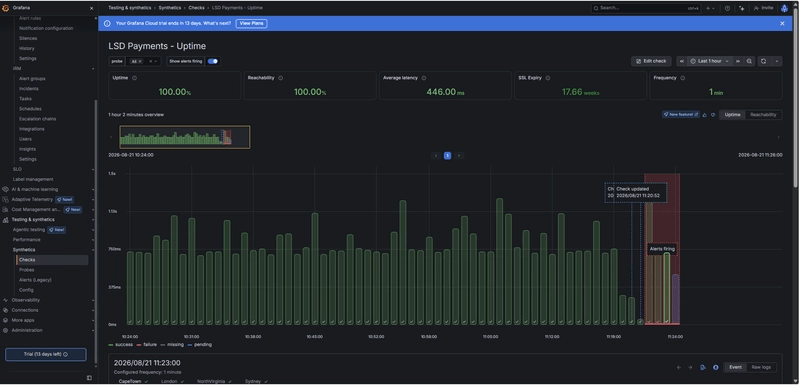


The entire lifecycle was end-to-end: detect, diagnose, approve, remediate, recover.
Without a service mesh, enforcing these boundaries becomes significantly harder. Istio provides workload identity via SPIFFE/SPIRE, mutual TLS on every connection, AuthorizationPolicy enforcement at the sidecar level, and full request telemetry through Envoy - without touching application code.
The AI agent does not need to be trusted. The mesh verifies identity and enforces policy on every connection. That distinction is critical.

AI agents are becoming increasingly capable. That makes architectural guardrails more important, not less.
NEXUS was built to explore a different model: an AI agent that can see everything it needs to diagnose a problem, while remaining cryptographically prevented from becoming the solution itself.
The service mesh enforces the boundaries. The AI performs the analysis. The engineer remains accountable for the decision.
That may be the most practical path toward operating AI safely in production environments.