
9.0
重磅
AI SCORE
模型发布2026-08-22 22:00
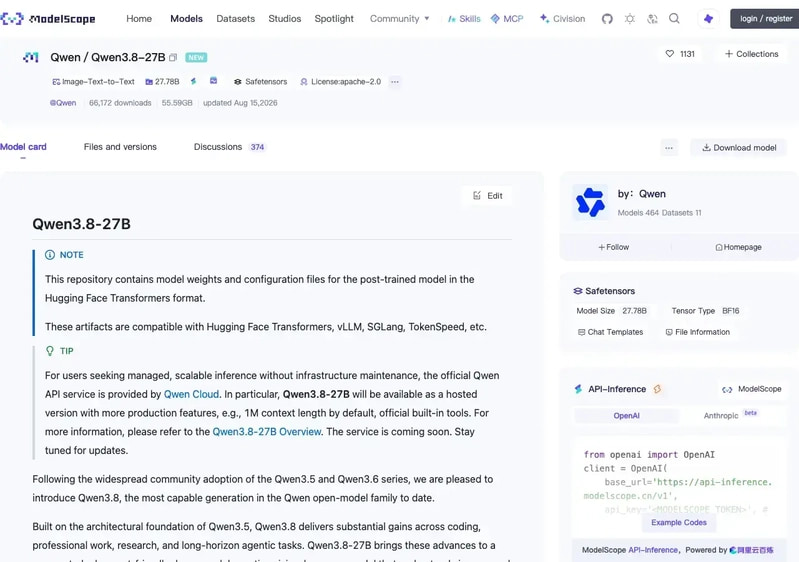
27B本地模型登顶编码榜:Qwen3.8-27B开源
dev.to · AI#Qwen#开源#代码模型
Editor brief · 编辑速览
阿里Qwen3.8-27B以Apache-2.0开源,在SWE-bench Pro、DeepSWE等编码benchmark上超越Claude Opus4.6 Max,DeepSWE从13.3跃升至42.2,OSWorld/浏览器使用任务同样第一。
block per request — direct answers when you want them.
enable_thinking:False 取消每次请求的 <think>...</think> 块——在你需要时给出直接答案。
Paragraph 21: reasoning_effort adjusts thinking depth: xhigh, medium, low. You control the balance between depth and cost.
reasoning_effort 调整思考深度:xhigh、medium、low。由你控制深度与成本的平衡。
Paragraph 22: preserve_thinking (enabled by default) maintains reasoning context across turns, so multi-turn conversations don't lose track of how they arrived at a point.
preserve_thinking(默认启用)保留跨轮次的推理上下文,使多轮对话不会丢失之前的推理路径。
Paragraph 23: This approach surpasses the typical binary thinking toggle: turn off chat mode for hard problems at xhigh, all with the same model.
这种方法超越了通常的全或无思考开关:用同一模型,聊天模式关闭,困难问题用 xhigh。
Paragraph 24: The multimodal agent scores reflect the same trend:
多模态代理分数呈现相同的趋势:
Paragraph 25: OSWorld-Verified (computer use): 84.3, up from 63.9
OSWorld-Verified(计算机使用):84.3,从 63.9 提升
Paragraph 26: WebArena-Verified (browser use): 64.8, up from 48.8
WebArena-Verified(浏览器使用):64.8,从 48.8 提升
Paragraph 27: AndroidWorld (mobile use): 81.9, first place
AndroidWorld(移动使用):81.9,第一名
Paragraph 28: RecreationBench (app recreation across desktop/mobile/web): 47.1, up from 29.8
RecreationBench(跨桌面/移动/网络的 App 复现):47.1,从 29.8 提升
Paragraph 29: SWE-MM (multimodal software engineering): 38.6, up from 25.7
SWE-MM(多模态软件工程):38.6,从 25.7 提升
Paragraph 30: Vision2Web (visual web development): 62.9, up from 45.0
Vision2Web(视觉网页开发):62.9,从 45.0 提升
Paragraph 31: Interpreting these results correctly: the model isn't merely engaging in conversation—it's actually manipulating real interfaces. Desktop environments, web browsers, and mobile screens are all within its capabilities. This demonstrates the strength of native multimodal training combining text, images, and video.
正确理解这些数字:模型不仅仅是在对话——它在操作真实的界面。桌面、浏览器、手机屏幕都在其能力范围内。这正是原生多模态训练的优势:文本、图像和视频协同训练。
Paragraph 32: Self-hosted deployment is well-supported: vLLM offers an official recipe, SGLang provides a cookbook, TokenSpeed is supported, and Hugging Face Transformers runs natively.
自托管部署有充分支持:vLLM 有官方方案,SGLang 有参考手册,TokenSpeed 被支持,Hugging Face Transformers 原生运行。
Paragraph 33: An API-hosted version through Qwen Cloud is forthcoming, featuring 1M context by default and integrated tools.
API 服务方面,Qwen Cloud 的托管版本即将推出,默认提供 1M context 并内置工具。
Paragraph 34: On the edge side, MediaTek announced Day-0 support for the Dimensity cockpit platform C-X1 and flagship mobile chips at release. On a 64-core XuanTie C950 target configuration, decoding achieves 30+ tokens/s with a 1.9-second TTFT.
在端侧,MediaTek 在发布当天宣布了对 Dimensity 座舱平台 C-X1 及旗舰手机芯片的 Day-0 支持。在 64 核 XuanTie C950 目标配置下,解码速度达到 30+ tokens/s,TTFT 为 1.9 秒。
Paragraph 35: Two implementation details to note: full-frame video input currently requires vLLM with --media-io-kwargs '{"video": {"num_frames": -1}}', and when using Qwen Cloud API, disable thinking using "enable_thinking": False instead of the local chat_template_kwargs approach.
有两个需要注意的实现细节:全帧视频输入目前需要通过 vLLM 使用 --media-io-kwargs '{"video": {"num_frames": -1}}',而调用 Qwen Cloud 时,要用 "enable_thinking": False 而非本地 chat_template_kwargs 的写法来关闭思考。
Paragraph 36: Before getting caught up in the excitement: HLE is 30.8 versus Opus4.6 Max's 40.0, and GPQA still favors the cloud flagship. No one should claim this 27B dense model outperforms frontier cloud models across the board.
在过度炒作之前,需要理性看待:HLE 为 30.8,而 Opus4.6 Max 为 40.0;GPQA 仍由云端旗舰领先。任何声称这个 270 亿稠密模型全面超越前沿云端模型的说法都是不成立的。
Paragraph 37: Though "a local 27B approaching cloud flagship performance" would've been unimaginable a year ago. Now it's downloadable.
不过,"一款本地运行的 270 亿模型触及云端旗舰的边缘",在一年前是不可想象的。现在只需下载即可。
Paragraph 38: This release addresses several key questions: dense small models are demonstrating stronger performance gains than expected, with first place across multiple agentic leaderboards and official confirmation that it surpasses Qwen's own larger Qwen3.7-Plus variant.
这次发布解决了几个关键问题:稠密小模型的表现正在超越预期,在多个 agentic 榜单上获得第一,并正式确认超越了 Qwen 自身更大的 Qwen3.7-Plus 版本。
Paragraph 39: Architecture innovations are delivering real dividends. Hybrid linear attention addresses the long-context cost problem effectively; 262K native context with 1M extension capability keeps open models competitive in the context window arms race.
架构创新正在产生实际收益。混合线性注意力有效解决了长上下文的成本问题;262K 原生 context 配合 1M 扩展能力,使开源模型在 context 窗口的竞争中保持竞争力。
Paragraph 40: The open ecosystem continues to strengthen. Over 460 Qwen models have been open-sourced under Apache-2.0, with full framework support and silicon vendors adapting from day zero.
开源生态持续壮大。460 多款 Qwen 模型已采用 Apache-2.0 开源,提供完整的框架支持,芯片厂商在第一天就已适配。
Paragraph 41: The model is available on Hugging Face: Qwen/Qwen3.8-27B. With a single vLLM command, you can deploy it for serving.
模型已在 Hugging Face 上发布:Qwen/Qwen3.8-27B。只需一条 vLLM 命令,即可部署服务。
Paragraph 42: For further actions, you may consider blocking this person and/or reporting abuse.
如需进一步操作,你可以考虑屏蔽此人或举报滥用。
Now I need to create the mindmap. Let me structure it:
Center: Qwen3.8-27B 开源霸榜 (10 chars or less) Main branches (3-6, each with 2-4 sub-nodes, each ≤14 chars):
基准测试登顶
Agent 能力飞跃
架构创新
思考可控性
部署生态
局限与定位
验证我的节点数量和字符限制:中心主题和所有分支标题都在规定范围内。每个节点保持了简洁性,使用中文标注技术术语便于理解。现在需要检查整个结构的逻辑流畅性和信息完整性。
Center: Qwen3.8-27B 开源霸榜
Main branches:
基准测试登顶
Agent 能力飞跃
架构创新
思考可控性
部署生态
局限与定位
这个结构更加均衡,每个分支都保持了相应的深度和广度。 </think>
2026年8月14日,阿里巴巴 Qwen 团队开源了 Qwen3.8-27B:一款 270 亿参数的稠密模型,采用 Apache-2.0 许可证。
随后基准测试榜单出炉。SWE-bench Pro:61.7 — 第一名。
看看榜单上都有谁:Qwen3.6-27B、Qwen3.7-Plus、Muse Glimmer-30B,以及 Opus4.6 Max —— Anthropic 的旗舰云端模型。
一款可以本地运行的 270 亿参数模型,刚刚把云端旗舰挤下了榜首。官方仓库明确表示:这款 270 亿稠密模型在整体表现上优于更大的 Qwen3.7-Plus。
表格中最引人注目的数据是 DeepSWE 1.1(Agent 式编程):
Qwen3.6-27B 得分 13.3。Qwen3.8-27B 得分 42.2。相隔一代,跃升 3 倍。
同样的模式在各榜单上反复出现:
QwenSWEBench:49.3 → 79.0
OSWorld(计算机使用):63.9 → 84.3 — 第一名
WebArena(浏览器使用):48.8 → 64.8 — 第一名
LiveCodeBench v6:83.9 → 90.3 — 第一名
CoWorkBench(长时办公任务):61.0 → 70.7 — 第一名
Agents' Last Exam:Pass@1 10.6 → 20.4,分数 27.3 → 42.9 — 第一名
所有提升都集中在一个能力上:Agent 式工作——规划、对环境反馈做出反应、完成多步骤任务。
注意力机制从来不只是关乎质量,而是关乎成本。全注意力随序列长度呈 O(N²) 扩展。当上下文推到 100K 或 1M token 时,计算量急剧膨胀。
Qwen3.8-27B 的答案是这样一个简单配比:64 层,每 4 层为一组——每 1 层 Gated Attention(全注意力)搭配 3 层 Gated DeltaNet(线性注意力),重复 16 次。
线性注意力层以低成本吸收长序列和视觉 token。全注意力层保持困难推理的精度。你不必在每个模块上都付二次方的税。
该架构首次亮相于 Qwen3.5 —— Qwen 从零开始、原生多模态的基础模型,在交错的文本、图像和视频 token 上训练。Qwen3.8 在此基础上增加了多 token 预测(MTP),并搭载 262,144 原生 context,可通过 YaRN 扩展到 1,000,000。
一个真正有用的设计选择:模型默认会思考,但由你来决定。
enable_thinking: False 取消每次请求的 <think>...</think> 块——在你需要时给出直接回答。
reasoning_effort 调校深度:xhigh、medium、low。深度与成本的取舍由你决定。
preserve_thinking(默认开启)保留上一轮的思考上下文,使多轮对话不会遗忘是如何走到这里的。
这对产品构建者来说优于通常的全或无思考开关:聊天模式关闭,困难问题开 xhigh,同一个模型搞定。
多模态 Agent 分数讲述着同样的故事:
OSWorld-Verified(计算机使用):84.3,从 63.9 提升
WebArena-Verified(浏览器使用):64.8,从 48.8 提升
AndroidWorld(移动使用):81.9,第一名
RecreationBench(桌面/移动/Web 全平台 App 复现):47.1,从 29.8 提升
SWE-MM(多模态软件工程):38.6,从 25.7 提升
Vision2Web(视觉网页开发):62.9,从 45.0 提升
正确理解这些数字:模型不只是在聊天,而是在操作真实界面。桌面、浏览器、手机屏幕都是它的目标。这是原生多模态训练的成果:文本、图像、视频一起训练,包含长达数小时的视频。
自托管:vLLM 有官方配方,SGLang 有 Cookbook,TokenSpeed 被支持,Hugging Face Transformers 原生运行。
API:Qwen Cloud 托管版即将上线,默认 1M context,内置工具。
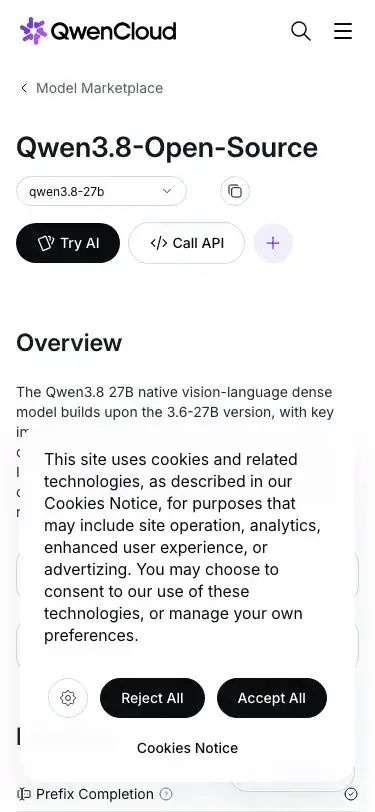
Edge:MediaTek 在发布当天宣布对 Dimensity 座舱平台 C-X1 及旗舰手机芯片进行 Day-0 适配。在 64 核 XuanTie C950 目标配置下,解码速度 30+ tokens/s,TTFT 1.9 秒。
两个注意事项:全帧视频输入目前通过 vLLM(--media-io-kwargs '{"video": {"num_frames": -1}}')工作;调用 Qwen Cloud 时,用 "enable_thinking": False 而非本地 chat_template_kwargs 的写法来关闭思考。
在 hype 之前先泼盆冷水:HLE 为 30.8 vs Opus4.6 Max 的 40.0,GPQA 仍归云端旗舰。没有人应该声称一个 270 亿稠密模型全面超越了前沿云端模型。
但"一款本地 27B 触及云端旗舰边缘",在一年前是不可想象的。现在,只需下载即可。
这次发布定调了三件事:
稠密小模型正在上攻。 多个 Agent 式榜单第一,官方声明击败了 Qwen 自己更大的 Qwen3.7-Plus。本地部署的价值主张终于有了旗舰级分数撑腰。
架构红利正在兑现。 混合线性注意力解决了长 context 成本问题;262K 原生加 1M 扩展,让开源模型在 context 军备竞赛中不掉队。
开源生态正在复利。 460+ Qwen 模型开源、Apache-2.0、全框架支持、芯片厂商 Day-0 适配。
模型在 Hugging Face:Qwen/Qwen3.8-27B。一条 vLLM 命令即可上线服务。