# React16.3新的生命周期详解|博客系列
> 本文详细介绍了React 16.3及之前版本的生命周期函数变化、各生命周期方法的作用与使用场景,帮助开发者理解组件的挂载、更新、卸载流程及新旧生命周期的区别,适合React开发者学习和查阅。
- 原文:https://feinterview.poetries.top/docs/fe-blog-docs/blog-docs/react/-React16.3%E6%96%B0%E7%9A%84%E7%94%9F%E5%91%BD%E5%91%A8%E6%9C%9F%E8%AF%A6%E8%A7%A3
- 来源:前端进阶之旅(feinterview.poetries.top)
- 更新:2025.10.25
---
## 一、React v16.0前的生命周期
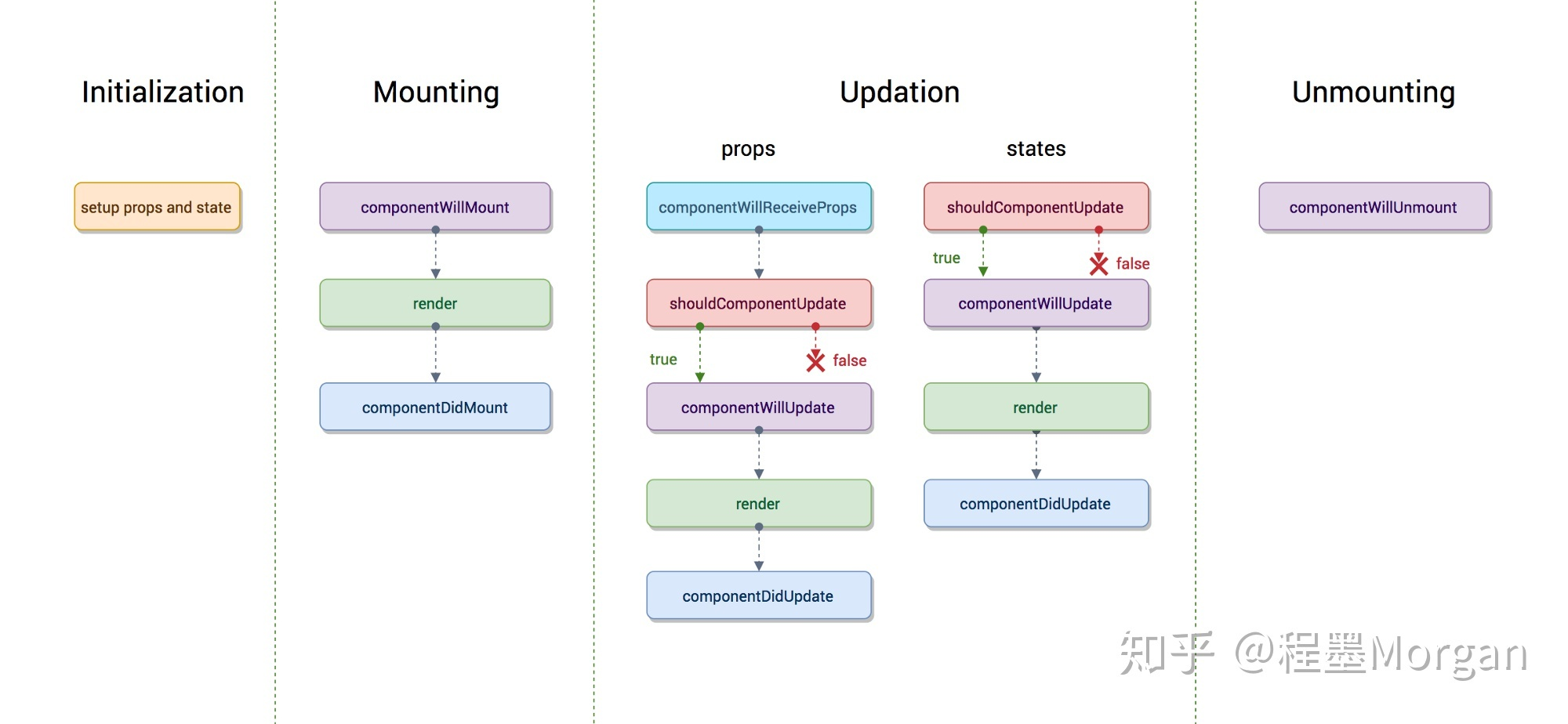
### 1.1 第一个是组件初始化(initialization)阶段
> 也就是以下代码中类的构造方法( `constructor()` ),Test类继承了react `Component`这个基类,也就继承这个`react`的基类,才能有`render()`,生命周期等方法可以使用,这也说明为什么函数组件不能使用这些方法的原因
`super(props)`用来调用基类的构造方法( `constructor()` ), 也将父组件的props注入给子组件,功子组件读取(组件中`props`只读不可变,`state`可变)而`constructor()`用来做一些组件的初始化工作,如定义`this.state`的初始内容
```js
import React, { Component } from 'react';
class Test extends Component {
constructor(props) {
super(props);
}
}
```
### 1.2 第二个是组件的挂载(Mounting)阶段
**此阶段分为componentWillReceiveProps,shouldComponentUpdate,componentWillUpdate,render,componentDidUpdate**
#### 1.2.1 componentWillMount
> 在组件挂载到DOM前调用,且只会被调用一次,在这边调用`this.setState`不会引起组件重新渲染,也可以把写在这边的内容提前到`constructor()`中,所以项目中很少用
#### 1.2.2 render
> 根据组件的`props`和`state`(无两者的重传递和重赋值,论值是否有变化,都可以引起组件重新`render`) ,`return` 一个`React`元素(描述组件,即`UI`),不负责组件实际渲染工作,之后由`React`自身根据此元素去渲染出页面`DOM`。`render`是纯函数(`Pure function`:函数的返回结果只依赖于它的参数;函数执行过程里面没有副作用),不能在里面执行`this.setState`,会有改变组件状态的副作用
#### 1.2.3 componentDidMount
> 组件挂载到`DOM`后调用,且只会被调用一次
### 1.3 第三个是组件的更新(update)阶段
> `setState`引起的`state`更新或父组件重新`render`引起的`props`更新,更新后的`state`和`props`相对之前无论是否有变化,都将引起子组件的重新`render`
#### 1.3.1 造成组件更新有两类(三种)情况
**1. 父组件重新render**
> 父组件重新`render`引起子组件重新`render`的情况有两种
- a. 直接使用,每当父组件重新`render`导致的重传`props`,子组件将直接跟着重新渲染,无论`props`是否有变化。可通过`shouldComponentUpdate`方法优化
```js
class Child extends Component {
shouldComponentUpdate(nextProps){ // 应该使用这个方法,否则无论props是否有变化都将会导致组件跟着重新渲染
if(nextProps.someThings === this.props.someThings){
return false
}
}
render() {
return {this.props.someThings}
}
}
```
- b.在`componentWillReceiveProps`方法中,将`props`转换成自己的`state`
```jsx
class Child extends Component {
constructor(props) {
super(props);
this.state = {
someThings: props.someThings
};
}
componentWillReceiveProps(nextProps) { // 父组件重传props时就会调用这个方法
this.setState({someThings: nextProps.someThings});
}
render() {
return {this.state.someThings}
}
}
```
> 在该函数(`componentWillReceiveProps`)中调用 `this.setState()` 将不会引起第二次渲染
是因为`componentWillReceiveProps`中判断`props`是否变化了,若变化了,`this.setState`将引起`state`变化,从而引起`render`,此时就没必要再做第二次因重传`props`引起的`render`了,不然重复做一样的渲染了
**2. 组件本身调用setState,无论state有没有变化。可通过shouldComponentUpdate方法优化**
```jsx
class Child extends Component {
constructor(props) {
super(props);
this.state = {
someThings:1
}
}
shouldComponentUpdate(nextStates){ // 应该使用这个方法,否则无论state是否有变化都将会导致组件重新渲染
if(nextStates.someThings === this.state.someThings){
return false
}
}
handleClick = () => { // 虽然调用了setState ,但state并无变化
const preSomeThings = this.state.someThings
this.setState({
someThings: preSomeThings
})
}
render() {
return {this.state.someThings}
}
}
```
#### 1.3.2 componentWillReceiveProps(nextProps)
> 此方法只调用于`props`引起的组件更新过程中,参数`nextProps`是父组件传给当前组件的新`props`。但父组件`render`方法的调用不能保证重传给当前组件的`props`是有变化的,所以在此方法中根据`nextProps`和`this.props`来查明重传的`props`是否改变,以及如果改变了要执行啥,比如根据新的`props`调用`this.setState`出发当前组件的重新`render`
#### 1.3.3 shouldComponentUpdate(nextProps, nextState)
> 此方法通过比较`nextProps`,`nextState`及当前组件的`this.props`,`this.state`,返回`true`时当前组件将继续执行更新过程,返回`false`则当前组件更新停止,以此可用来减少组件的不必要渲染,优化组件性能。
ps:这边也可以看出,就算`componentWillReceiveProps()`中执行了`this.setState`,更新了`state`,但在`render`前(如`shouldComponentUpdate`,`componentWillUpdate`),`this.state`依然指向更新前的`state`,不然`nextState`及当前组件的`this.state`的对比就一直是`true`了
#### 1.3.4 componentWillUpdate(nextProps, nextState)
> 此方法在调用`render`方法前执行,在这边可执行一些组件更新发生前的工作,一般较少用
#### 1.3.5 componentDidUpdate(prevProps, prevState)
> 此方法在组件更新后被调用,可以操作组件更新的`DOM`,`prevProps`和`prevState`这两个参数指的是组件更新前的`props`和`state`
### 1.4 卸载阶段
> 此阶段只有一个生命周期方法:`componentWillUnmount`
此方法在组件被卸载前调用,可以在这里执行一些清理工作,比如清楚组件中使用的定时器,清除`componentDidMount`中手动创建的`DOM`元素等,以避免引起内存泄漏
## 二、React v16.4 的生命周期
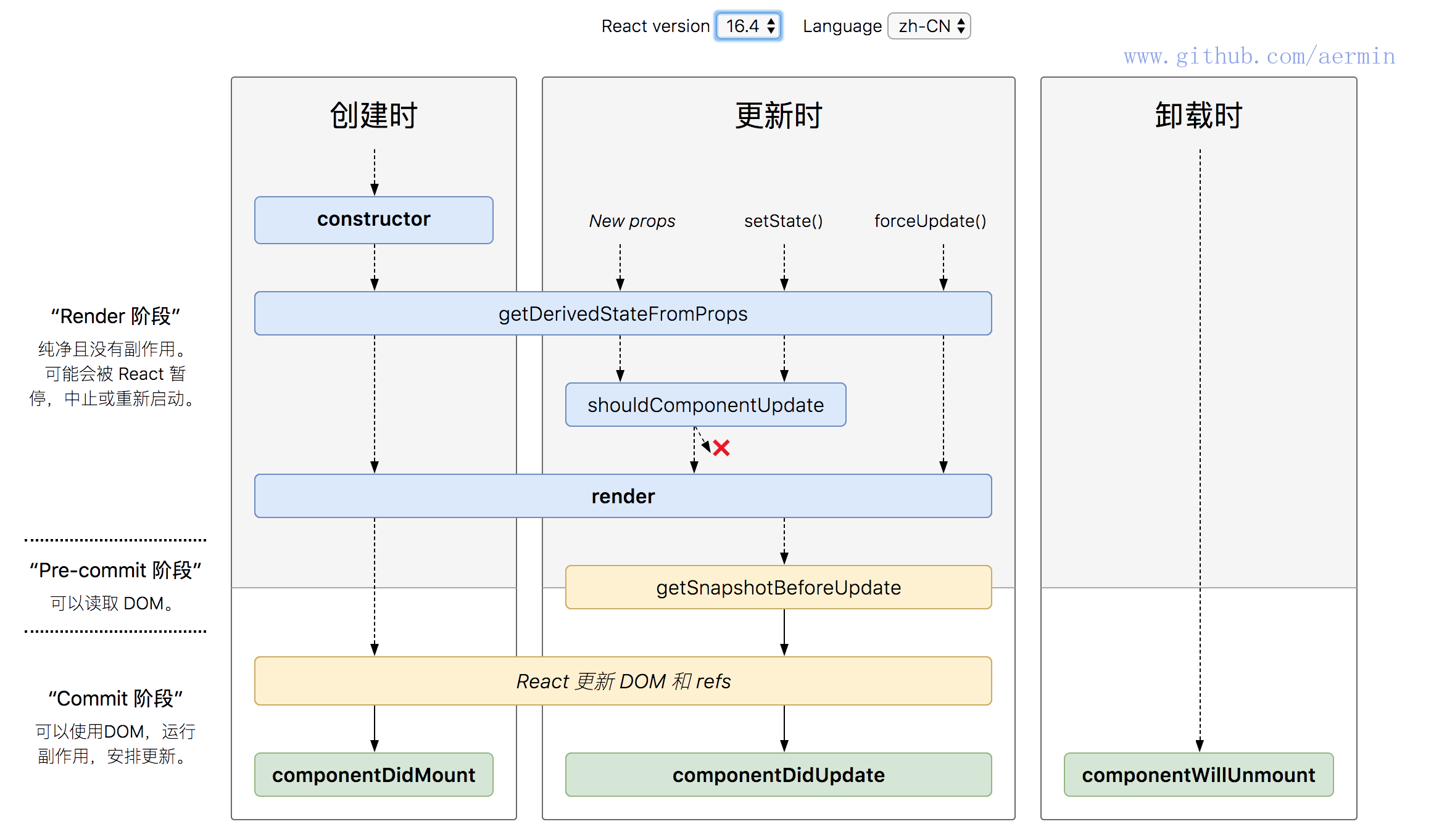
**React v16.4 的生命周期图**
### 2.1 变更缘由
> 原来(`React v16.0`前)的生命周期在`React v16`推出的`Fiber`之后就不合适了,因为如果要开启`async rendering`,在`render`函数之前的所有函数,都有可能被执行多次
**原来(React v16.0前)的生命周期有哪些是在render前执行的呢?**
- `componentWillMount`
- `componentWillReceiveProps`
- `shouldComponentUpdate`
- `componentWillUpdate`
> 如果开发者开了`async rendering`,而且又在以上这些`render`前执行的生命周期方法做`AJAX`请求的话,那`AJAX`将被无谓地多次调用。而且在`componentWillMount`里发起`AJAX`,不管多快得到结果也赶不上首次`render`,而且`componentWillMount`在服务器端渲染也会被调用到
- 所以除了`shouldComponentUpdate`,其他在`render`函数之前的所有函数(`componentWillMount`,`componentWillReceiveProps`,`componentWillUpdate`)都被`getDerivedStateFromProps`替代
- 也就是用一个静态函数`getDerivedStateFromProps`来取代被`deprecate`的几个生命周期函数,就是强制开发者在`render`之前只做无副作用的操作,而且能做的操作局限在根据`props`和`state`决定新的`state`
> React v16.0刚推出的时候,是增加了一个`componentDidCatch`生命周期函数,这只是一个增量式修改,完全不影响原有生命周期函数;但是,到了`React v16.3`,大改动来了,引入了两个新的生命周期函数
### 2.2 引入了两个新的生命周期函数
#### 2.2.1 getDerivedStateFromProps
> `getDerivedStateFromProps`本来(React v16.3中)是只在创建和更新(由父组件引发部分),也就是不是不由父组件引发,那么`getDerivedStateFromProps`也不会被调用,如自身`setState`引发或者`forceUpdate`引发
**React v16.3 的生命周期图**
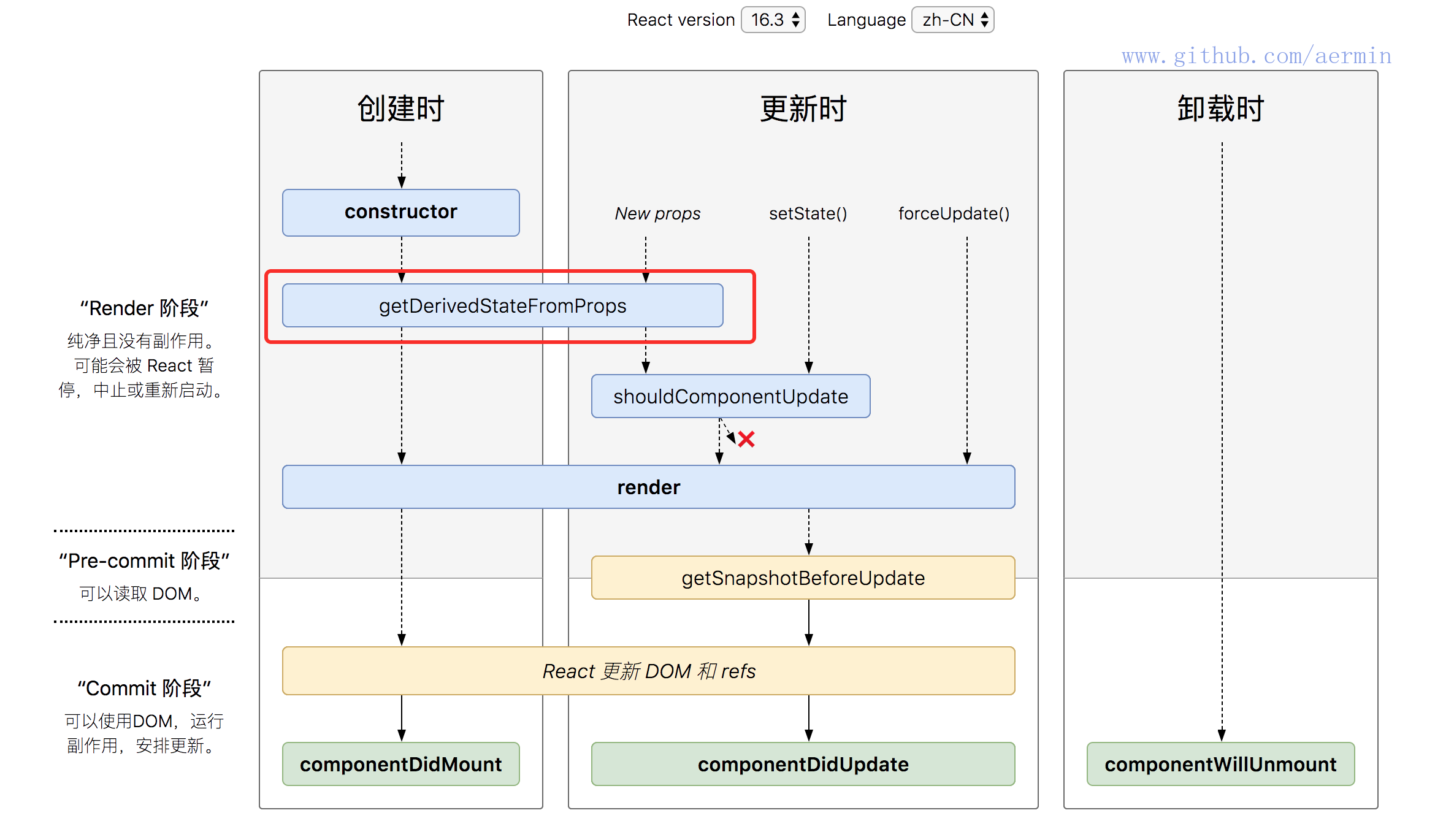
> 这样的话理解起来有点乱,在`React v16.4`中改正了这一点,让`getDerivedStateFromProps`无论是`Mounting`还是`Updating`,也无论是因为什么引起的`Updating`,全部都会被调用,具体可看`React v16.4 `的生命周期图
**React v16.4后的getDerivedStateFromProps**
> `static getDerivedStateFromProps(props, state)` 在组件创建时和更新时的render方法之前调用,它应该返回一个对象来更新状态,或者返回`null`来不更新任何内容
#### 2.2.2 getSnapshotBeforeUpdate
> `getSnapshotBeforeUpdate()` 被调用于`render`之后,可以读取但无法使用DOM的时候。它使您的组件可以在可能更改之前从DOM捕获一些信息(例如滚动位置)。此生命周期返回的任何值都将作为参数传递给`componentDidUpdate()`
官网给的例子
```js
class ScrollingList extends React.Component {
constructor(props) {
super(props);
this.listRef = React.createRef();
}
getSnapshotBeforeUpdate(prevProps, prevState) {
//我们是否要添加新的 items 到列表?
// 捕捉滚动位置,以便我们可以稍后调整滚动.
if (prevProps.list.length < this.props.list.length) {
const list = this.listRef.current;
return list.scrollHeight - list.scrollTop;
}
return null;
}
componentDidUpdate(prevProps, prevState, snapshot) {
//如果我们有snapshot值, 我们已经添加了 新的items.
// 调整滚动以至于这些新的items 不会将旧items推出视图。
// (这边的snapshot是 getSnapshotBeforeUpdate方法的返回值)
if (snapshot !== null) {
const list = this.listRef.current;
list.scrollTop = list.scrollHeight - snapshot;
}
}
render() {
return (
{/* ...contents... */}
);
}
}
```
## 三、参考
- [React v16.3之后的组件生命周期函数](https://zhuanlan.zhihu.com/p/38030418)