
8.0
热点
AI SCORE
技术实践2026-08-13 15:25
一致性≠正确性:企业AI需要持续评估的R.A.H.S.I.框架
dev.to · AI#AI评估#Agent#企业AI
Editor brief · 编辑速览
文章指出企业 AI 系统可能输出稳定但错误的结果,提出 R.A.H.S.I. 评估框架,强调需从结果和过程两个维度持续评估 Agent:是否完成任务、是否遵守指令、是否选对工具、输出是否安全等。
🛡️ Need implementation, not just insights? Let's build the release gate before agent scale removes the opportunity.
🛡️ Read Complete Article |
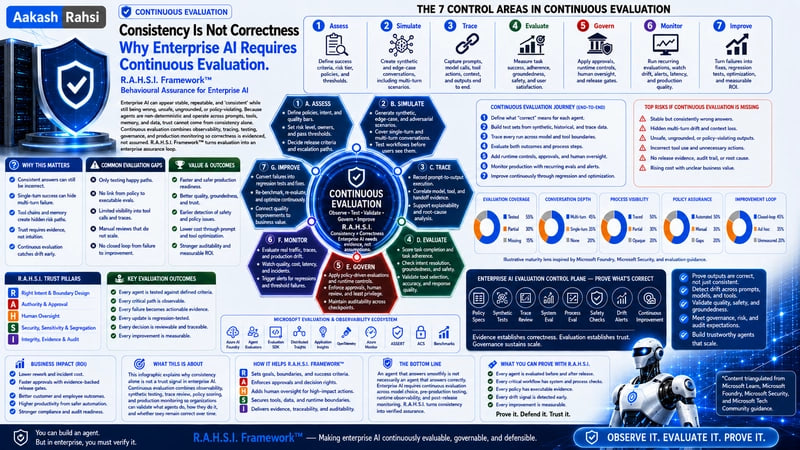
Consistency is not correctness. Enterprise AI requires continuous evaluation to prove outcomes, tool use, safety, and trust at scale. Always
Hire Aakash Rahsi | Expert in Intune, Automation, AI, and Cloud Solutions
Hire Aakash Rahsi, a seasoned IT expert with over 13 years of experience specializing in PowerShell scripting, IT automation, cloud solutions, and cutting-edge tech consulting. Aakash offers tailored strategies and innovative solutions to help businesses streamline operations, optimize cloud infrastructure, and embrace modern technology. Perfect for organizations seeking advanced IT consulting, automation expertise, and cloud optimization to stay ahead in the tech landscape.
An AI system can produce the same answer repeatedly—and still be wrong.
That distinction matters as enterprises move from copilots to agents that reason across multiple turns, select tools, execute actions and operate inside business workflows.
Consistency is repeatability. Correctness is evidence.
Microsoft's current Foundry and Zero Trust guidance reinforces a critical shift: enterprise AI cannot be judged only by whether an output looks stable, fluent or plausible.
It must be continuously evaluated across both outcome and process.
Did the agent complete the task?
Did it follow its instructions?
Did it select the correct tool?
Were the tool inputs accurate?
Did it use tool outputs correctly?
Was the response grounded, relevant and safe?
Did performance change across a multi-turn session?
Microsoft Foundry now treats evaluation, tracing and production monitoring as connected observability capabilities. Agent evaluators examine both end-to-end results and step-by-step execution, while production evaluation can detect quality or safety degradation after deployment.
This matters because agentic failure is rarely one-dimensional.
A final answer can look correct while the execution path is wrong.
A tool call can succeed technically while violating task intent.
A model can behave consistently while consistently producing an ungrounded result.
And an evaluator itself must be validated—not blindly trusted.
This changes the enterprise question
"Does the AI usually give us the same answer?"
"Can we continuously demonstrate that its outcomes, decisions, tool use and behaviour remain within an evidence-backed definition of acceptable performance?"
That requires evaluation before deployment, evaluation during production, regression against benchmarks, multi-turn assessment and controls that turn observed failures into measurable assurance signals.
Continuous evaluation is not model testing. It is a control function.
The R.A.H.S.I. Framework™ focuses on that assurance gap—where AI performance must become observable, testable and defensible throughout operation.